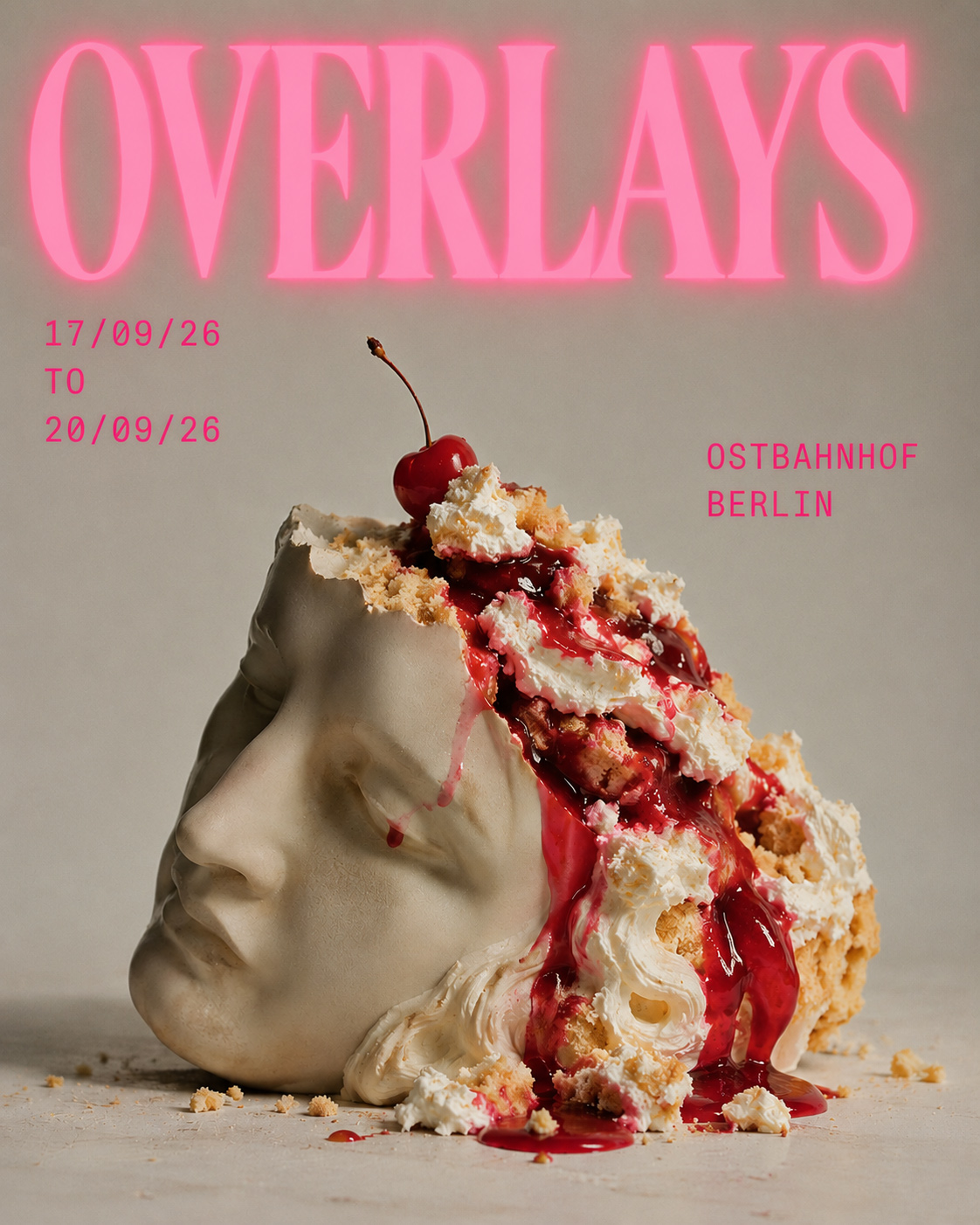
OVERLAYS
groupshow on view 17/09/2026 → 20/09/2026
 Ostbahnof (ground floor), 10243 Berlin, Germany
| vernissage | friday | saturday | finissage |
|---|---|---|---|
| 17/09/26 | 18/09/26 | 19/09/26 | 20/09/26 |
| 6 → 10:30 pm | 3 → 7 pm | 3 → 7 pm | 6 → 10:30 pm |
→ APÉRITIF @ 6pm & PERFORMANCE(S) @ 8pm for vernissage
| BLUEPRINT | OPEN CALL | CATALOG | MEDIATION |
Abstract
The music of two tabs open at once, neon underpaint bleeding through the surface, an exposed wall nobody bothered to cover. What if opposites aren’t kept apart, but folded into one another until the seam itself becomes the subject? The work stacks rather than resolves, piling the lush onto the wrong and trusting the friction to hold.
The result is a chimera, an image built from titillating pairings: heroin and cheesecake, the sweet pressed flat against the sour until neither can be parsed alone. This is the side of excess over editing where each piece arrives as a single creature stitched from incompatible appetites. Not a contradiction to be solved, but one to be savored.
It is no different with Shakespeare, that astonishing Spanish-Moorish-Saxon synthesis of tastes over which an ancient Athenian of the circle of Aeschylus would have half-killed himself with laughter or annoyance: but we—we accept precisely this confusion of colors, this medley of the most delicate, the coarsest and the most artificial, with a secret confidence and cordiality, we enjoy him as an artistic refinement reserved precisely for us and allow ourselves to be as little disturbed by the repellent fumes and the proximity of the English rabble in which Shakespeare’s art and taste live as we do on the Chiaja of Naples, where we go our way enchanted and willing with all our senses alert, however much the sewers of the plebeian quarters may fill the air. That as men of the “historical sense” we have our virtues is not to be denied—we are unpretentious, selfless, modest, brave, full of self-restraint, full of devotion, very grateful, very patient, very accommodating—with all that, we are perhaps not very “tasteful.”
— Friedrich Nietzsche, Beyond Good and Evil (1886, §224)
Artists
Kenneth Wiatrek
is a Berlin-based artist and creative director whose practice explores the tension between digital precision and tactile, human execution. Utilizing an advanced digital plotting process alongside hands-on mediums like collage, acrylic, and collaborative oil painting factories, Wiatrek translates digital files into tangible, textured physical realities. Conceptually, his work investigates the dialogue between the sterile accuracy of code based digital art and the warmth of physical imperfection, questioning how digital identity and technological automation translate into tangible human experience. Based in Berlin for nearly two decades after relocating from Texas, his experimental, mixed-media works capture a compelling intersection of technological systems, hand-crafted materiality, and the shifting boundaries between the digital and the analog.
Anna Niedhart
is a painter whose figures surface like memories—half-formed, luminous, and resistant to resolution. Working with pigments on light grounds, Niedhart allows bodies to emerge from the process rather than imposing them, moving between softness, absence, and uncomfortable presence. The practice extends across paper, silk, canvas, and porcelain to explore states without clean names: tender and grotesque, sensual yet cerebral, cruel yet gentle. Through close attention to care, self-display, performed softness, and vanity as survival, Niedhart overturns conventions of portraiture to evoke compassion and revulsion, beauty and distortion. By stripping away disguise, the work reveals something visceral, sublime, and at times humorous.
Robert Seidel
is a Berlin-based artist whose work pushes the boundaries of abstract beauty through cinematographic approaches informed by science and technology. Through the organic interplay of structural, spatial, and temporal concepts, Seidel creates continuously evolving complexity from which a narrative skeleton emerges, inviting viewers to connect with the work on an evolutionary and symbolic level. His projections, installations, and experimental films have been presented at international festivals, galleries, and museums including the Palais des Beaux-Arts Lille, ZKM Karlsruhe, Art Center Nabi Seoul, Young Projects Los Angeles, Museum of Image and Sound São Paulo, and MOCA Taipei. His films have received numerous distinctions, including the KunstFilmBiennale Honorary Award and the Visual Music Award.
Stas Leontyev
is a multidisciplinary artist whose meditative, process-driven practice explores time, space, and the condition of being in-between. Across installation, drawing, text, photography, and experimentation, Leontyev creates situations in which time and material become collaborators, allowing works to emerge through repetition, exposure, erosion, chance, and gradual transformation. By reducing the artist’s direct gesture, the work foregrounds duration, environment, and natural processes. Informed by a background spanning graphic design, psychology, economics, and literary theory, Leontyev seeks to slow perception and make subtle transformations visible, allowing uncertainty to remain unresolved and the artwork to exist as a temporary condition shaped by time.
Don Elektro
is a Germany-based artist whose practice is rooted in more than a decade of ongoing internet research. Treating the web as an archive, social space, and image repository, Don Elektro moves between digital culture, contemporary politics, popular mythology, and subcultures to examine the infrastructures shaping belief, suspicion, and collective imagination. Conspiracy becomes not simply irrationality, but a mirror of the systems and power structures organizing everyday life. Across installation, graphic design, publishing, moving image, objects, digital media, and group performance, collected fragments are displaced and recombined until research material and finished work converge. His work has been exhibited internationally in Rotterdam, New York, London, Prague, and beyond. Don Elektro is also a member of the K.O.T.Z. art collective.
Ege Doğan
is a Berlin-based artist born in Turkey in 1995. Doğan’s practice searches for meaning in what is absent and unfolds across two distinct bodies of work: fabric sculptures and installations exploring memory and identity, and oil paintings examining how meaning is constructed through images. Doğan approaches making as contemplation through practice, working spontaneously and allowing meaning to emerge before assembling its fragments into uneasy unions.
Alisa Nedashkovska
is a Berlin-based sound artist and composer from Ukraine working with performative sound design, archival audio research, and custom contact-microphone techniques. Her practice focuses on amplifying gestures, surfaces, and material processes, combining tactile input with electronic structures and spoken-word elements.
Amelia McConville
is a researcher interested in visual poetics and cultural theory. Her PhD at Trinity College Dublin explored the reciprocal relationship between visual poetry and the Neurohumanities. She co-founded the ART+SCIENCE SALON, a network and event series where art, science, and culture meet, and also organises experimental events with XD Network in Berlin. McConville is currently a postdoctoral researcher at the Berlin Hub for Science & Society at the Museum für Naturkunde.
Maria D.
is a Berlin-based artist born in the Caucasus who studies Fine Arts at the Universität der Künste (UdK). Her practice combines mixed media and performance to explore the body, recycled materials, and transformation. Maria D. investigates how materials can alter perceptions of the body and create new forms between the familiar and the abstract.
GourmetShit007
is anonymous online artist posting on Reddit, GourmetShit007 documents their daily life through photographs pairing homemade food with recreational drug use. With two decades of sustained, functional use, the work shows a reality where dependency coexists with routine cooking and ordinary life. The images lean into stark visual contrasts, rich pastries beside powders, warm kitchen scenes against clinical preparation. By design, the juxtaposition disarms viewers. The artist seeks legislation change, believing shifting perception exposes how prohibition causes more harm than the substance itself. Whether this is effective activism, aesthetic provocation, or genuine documentation remains for the viewer to decide.
pskl
is a Berlin-based artist focused on the mutations caused by automation of the creative process. By encoding art direction into autonomous virtual machines, their output passively repurposes internet material into new results. Striving to summon a subjective soul into the machine realm, they also explore new methods of production that have inherent properties of scale.
Credits
Curation
- pskl (assisted by Quantum crew)